
Article Highlight | 25-Jun-2025
www.eurekalert.org
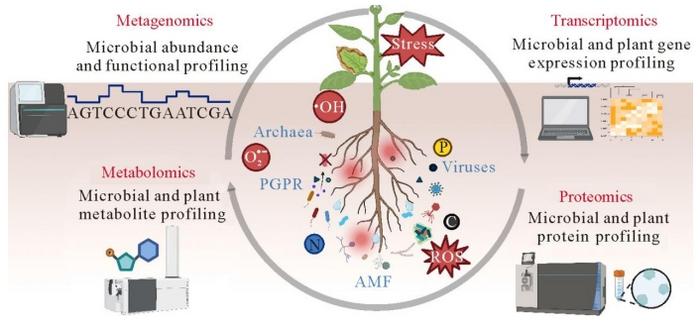
Multiomics approaches for understanding of the dynamic mechanisms of soil holobiont in mitigating salinity stress in plant hosts. PGPR = plant growth-promoting rhizobacteria; AMF = arbuscular mycorrhizal fungi.
Salinity is a rising threat to global agriculture, severely limiting crop productivity and damaging soil health. New research reveals how the microscopic world beneath our feet might be the key to solving this issue. Soil microbiomes, including bacteria, fungi, and archaea, play an unexpected yet critical role in helping plants survive salinity stress. By promoting plant growth and improving stress resilience, these microorganisms could be harnessed as a sustainable, eco-friendly solution to enhance agricultural output in saline soils.
With nearly 10% of the world’s land affected by high salinity, the impact on crop yield is devastating, with agricultural productivity in saline soils plummeting. Conventional methods to combat this stress have yielded limited success, and new strategies are urgently needed. The disruption of microbial communities in saline soils further complicates matters, as these microorganisms are essential for maintaining soil fertility and plant health. Given the growing concern over salinity’s impact on food security, there is a pressing need for deeper exploration into how soil microbes can be used to support plant growth under these harsh conditions. This challenge highlights the necessity of understanding microbial ecosystems and their potential role in mitigating salinity stress.
A recent study (DOI: 10.1016/j.pedsph.2024.09.002), published in Pedosphere in 2025, delves into the complex interplay between soil microorganisms and plants in salinity-affected environments. Led by a team from Kyungpook National University and the National Institute of Plant Genome Research, this research explores the potential of microbes such as plant growth-promoting bacteria (PGPB), archaea, and arbuscular mycorrhizal fungi (AMF) in enhancing plant resilience to salinity. The study offers promising insights into how these microbes could be integrated into sustainable agricultural practices, providing a natural, eco-friendly way to protect crops from the growing threat of salinity.
The study reveals that under salinity stress, certain soil microbes thrive, forming crucial partnerships with plants. Among them, bacteria like Gammaproteobacteria and Bacteroidetes, along with fungi and archaea, help plants adapt by regulating water and nutrient uptake, enhancing antioxidant defenses, and producing growth-promoting phytohormones like indole-3-acetic acid (IAA). These microorganisms also help mitigate the harmful effects of salt by activating stress-tolerance genes, including those responsible for osmotic adjustment and ion transport. Interestingly, while salinity reduces the overall microbial diversity in soils, it favors salt-tolerant species that bolster soil fertility and plant health. This symbiotic relationship plays a pivotal role in sustaining both plant growth and soil ecosystem stability. The study underscores the importance of multiomics research to better understand these microbial interactions, offering new avenues for utilizing microbes to combat salinity stress and improve agricultural productivity.
“Salinity stress is one of the most pressing challenges for global agriculture today,” said Dr. Jae-Ho Shin, lead author of the study. “Our research sheds light on the critical role that soil microbiomes play in alleviating this stress. By harnessing the power of these microorganisms, we can offer farmers a sustainable and eco-friendly alternative to conventional solutions, enhancing crop resilience and productivity in saline-affected areas.”
The implications of these findings are vast. By using plant growth-promoting microorganisms to enhance plant resilience, farmers could significantly reduce their dependence on chemical fertilizers and pesticides. The ability to restore soil health and promote sustainable farming practices in saline soils could revolutionize agriculture in regions affected by salinity. In the future, this research could lead to the development of microbial-based solutions tailored to specific crops and environments, offering a promising route for mitigating salinity stress and securing food production in a changing climate.